
Deficit
The body uses stored energy. Over time, body weight generally trends downward.
Start with the energy equation. Build a plan around food, movement, and habits you can maintain.
Find your calorie starting pointIllustrative numbers. Your needs are individual.
When you consistently consume less energy than your body actually uses, it must draw on stored energy. That is the fundamental driver of weight loss.[1]
A true calorie deficit necessarily reduces stored body energy. Food quality, exercise, and appetite management help create and sustain that deficit. They do not replace it.
The body uses stored energy. Over time, body weight generally trends downward.
Your balance point: intake roughly matches expenditure, so weight tends to remain stable.
Excess energy is stored. Over time, body weight generally trends upward.
Water retention, menstrual changes, constipation, and stored carbohydrate can conceal fat loss. Muscle gain can offset it on the scale. A flat reading does not prove there was no deficit, and an app’s calorie target does not prove there was one.
Compare weekly average weights over several weeks, alongside waist measurements and strength. Avoid changing the plan after one weigh-in.
If the trend stays flat, review portions, drinks, oils, tracking consistency, and activity. Calorie needs can fall as weight decreases.[1]
A larger deficit is not automatically better. Leave enough food to meet protein and nutrient needs and support training.[2]
Maintenance is the estimated daily intake that keeps your weight stable. A deficit sits below it. Enter your details and the estimates update automatically.
Enter your details to see your estimated maintenance calories and a moderate deficit starting point.
Meet your nutritional needs while managing portions. Simple, satisfying meals make consistency easier.
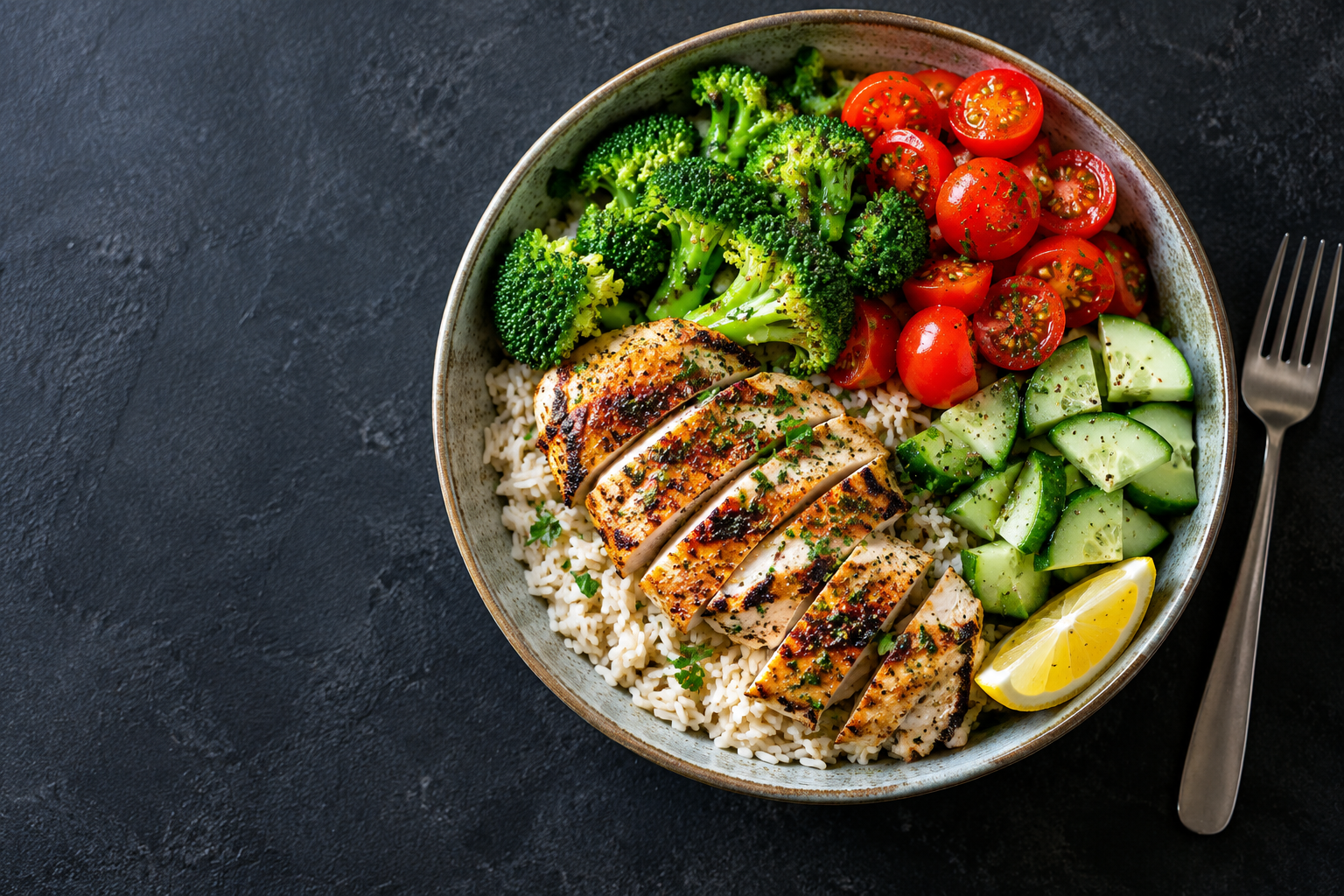 Protein + produce + a portion of carbohydrate
Choose mostly whole or minimally processed foods. Single-ingredient foods are a useful starting point; frozen vegetables, canned beans or fish, and plain yogurt can fit too.
Start with proteinChicken, fish, lean meat, eggs, plain Greek yogurt, cottage cheese, tofu, or beans.
Add color and volumeVegetables, whole fruit, and broth-based soups add variety and satisfying portions.
Round out the mealRice, oats, potatoes, whole grains, and measured portions of oils, nuts, or avocado.
Limit sugary drinks, frequent sweets, chips, and snacks that make excess calories easy to consume. When appetite is low, prioritize protein and variety rather than filling up only on low-calorie foods.[2]
Body-fat percentage can help estimate lean mass. It does not determine all three macro targets on its own. Calorie needs, activity, age, preferences, and medical conditions matter too.
200 lb at 30% body fat = 140 lb / 63.5 kg lean mass
Body-fat measurements are estimates. This framework is for generally healthy adults who resistance train; individual needs can differ from this example.
About 0.9 g per pound of estimated lean mass is an illustrative starting target. There is no single agreed calculation for everyone. Kidney disease and other nutritional conditions require individual guidance.[2][3]
Divide the allocated calories by 9 to get grams. Include appropriate portions of sources such as olive oil, nuts, and avocado.[4]
After protein and fat, divide the remaining calories by 4. Adjust for training, preferences, and medical needs.
For the 200 lb, 30% body-fat example, protein rounds to about 130 g. This breakdown is useful only if 2,000 calories is an appropriate intake for that person.
MyFitnessPal can help log meals, snacks, drinks, oils, and sauces. Check portions and labels, use a food scale when helpful, and match raw or cooked entries to how you weighed the food.
Build gradually from your current ability. Resistance training and adequate protein work together to preserve muscle during weight loss.[6]
Muscle uses energy at rest, supporting resting energy expenditure. An often-used estimate is roughly 6 calories per pound of muscle per day. The increase is modest, and overall energy balance still matters.[7]
Preserving muscle protects strength and physical function, while resistance training can help protect bone health. Protein alone does not replace training.
The step target is a practical goal, not a threshold for benefit. General adult guidance recommends at least 150 minutes of moderate activity and strengthening on two or more days weekly. Adapt around injuries and physical limitations.[5]
Cover the major movement patterns. Use controlled technique, manageable resistance, and gradual progression. A trainer can help adapt exercises around injuries.
Train on nonconsecutive days, leaving recovery time between sessions.
| Movement | Exercise examples |
|---|---|
| Legs | Squats, leg press, step-ups |
| Hips & posterior chain | Glute bridges, appropriately coached Romanian deadlifts |
| Upper-body push | Chest press, dumbbell bench press, incline push-ups |
| Upper-body pull | Seated rows, lat pulldowns |
| Core stability | Dead bugs, bird dogs, suitable plank variations |
“Single,” “dual,” and “triple” describe how many hormone receptors a medicine activates. They are not numbered versions of GLP-1, and more targets do not automatically mean a better choice for every person.
Ozempic · Wegovy
Acts on the GLP-1 receptor, helping regulate appetite, food intake, and blood sugar.
Ozempic is a brand of semaglutide. Wegovy also contains semaglutide and has weight-management indications. Ozempic’s indications center on type 2 diabetes and related outcomes; the products’ doses and uses differ.[15][16]
Mounjaro · Zepbound
Activates both GLP-1 and GIP receptors. Together, these actions help regulate glucose and reduce appetite and food intake.
This is the dual-action category. Zepbound has weight-management indications; Mounjaro is used for type 2 diabetes. Both contain tirzepatide.[17][18]
Often called “Reta” · Investigational
Adds glucagon receptor activity to GLP-1 and GIP activity. These pathways influence appetite, glucose regulation, and energy metabolism.
Retatrutide is a triple agonist. Its benefits, risks, and appropriate use continue to be studied.[19]
Explore the Reta protocolGLP-2 is a different gut hormone. GLP-2 medicines such as teduglutide are used for short bowel syndrome; the term does not mean dual-action weight-loss medicine.[20] “GLP-3” is an informal, scientifically inaccurate nickname sometimes used for retatrutide. The correct description is a GLP-1/GIP/glucagon triple agonist.[19]
These medicines require individual clinical assessment. Do not use GLP-1 medicines for weight loss during pregnancy or breastfeeding; retatrutide should also be avoided. Medication does not replace adequate nutrition or movement.[11]
Explore Reta’s three receptor targets, appetite management, the example schedule, and the transition discussion.
Understand abdominal fat, track progress, and support strength while managing obesity.
The growth-hormone pathway, a Sunday–Thursday course for eight weeks, and an eight-week break.
Patient-reported pain relief, recovery goals, and the proposed course and break.
Read the recovery guideGHK-CuSkin and hair goals, a proposed 12-week course, and a four-week break.
Read the copper-peptide guideMELANOTAN IInjectable Melanotan I, pigmentation, and a proposed course and maintenance schedule.
Read the Melanotan I guideUse ChatGPT for meal ideas, grocery lists, general nutrition questions, exercise explanations, and draft workout plans. Better context makes the suggestions more useful.
I’m {age} years old, {sex}, {height} tall, and weigh {weight}. My estimated body-fat percentage is {percentage—or unknown}. I average {steps} steps daily and strength train {number} times per week for approximately {minutes} minutes. My goal is to lose body fat while maintaining or building muscle. Estimate my maintenance calories and suggest a moderate calorie deficit. Based on this information, what should my daily protein, carbohydrate, and fat targets be in grams? Explain which body weight or lean-mass estimate you used, show the calculations, and check that the macros add up to the calorie target. Ask for any missing information that would materially change the estimate. Explain how to adjust these starting targets using several weeks of progress. Then create a practical meal plan using those targets. My food preferences, dietary requirements, budget, and cooking-time limits are {details}.
Check ChatGPT’s calculations against labels and tracking entries. It can help you plan and understand; medication decisions, concerning symptoms, and injury assessment require qualified care.
Content reviewed September 2026 · Educational information for adults